Did you know?
Every oil has its own character. A few curiosities to get you started.
How soap is made
A chemical reaction thousands of years old, that you can repeat in your own kitchen.
The reaction
Oil + lye → soap + glycerin. That is saponification. You always keep a little extra oil, the superfat (5 to 8%), for a mild soap with no leftover lye.
The methods
Cold process: the most common, it preserves the oils but needs 4 weeks of curing. Hot process: the batter is cooked, so the soap is ready sooner. Melt and pour starts from an already saponified base: no lye to handle.
Safety first
Gloves and goggles are a must: lye is highly corrosive. Always pour the lye into the water, never the reverse. And weigh everything, to the gram.
The calculator
- Lye (NaOH or KOH) and water worked out to the gram.
- Hardness, lather, conditioning, cleansing: your soap's qualities before you make it.
- Full fatty acid profile, updated in real time.
Soap making oils
SAP value, INS, fatty acid profile and amount of lye for every oil, butter, fat and wax used in soap making.
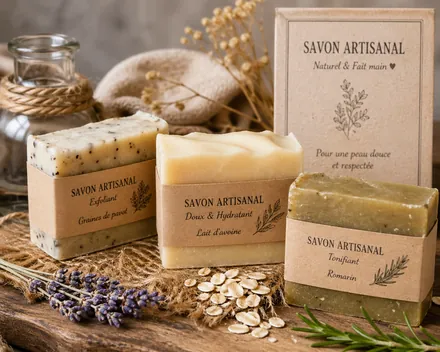
Ready to formulate your first soap?
Add your oils, set the superfat: the recipe appears instantly.